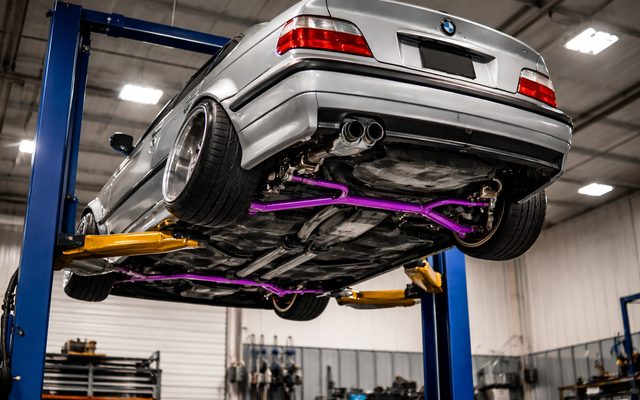
In the intensely competitive arena of modern professional drifting, victory is not merely purely a function of brute torque or driver aggression. Conversely, it has evolved into a multifaceted engineering challenge that requires a scrupulous fusion of selecting a time-tested chassis, outfitting it with the highest-quality drift-spec parts, and, most essentially, comprehending its dynamic characteristics on the track through sophisticated vehicle dynamics analysis tools. This definitive handbook will serve as your blueprint starting from the initial concept of a project car all the way to the final data-informed tweaks that elevate a powerful car into a repeatable champion. We will thoroughly explore the methodical process of vehicle alignment optimization, showing how a state-of-the-art vehicle dynamics tool like a dedicated telemetry system eradicates approximation and delivers unmatched clarity into your vehicle's true dynamics.
The bedrock of any successful drift machine is, undoubtedly, the chassis itself. Certain cars have attained iconic standing within the global sliding culture due to their natural weight distribution, strong construction, and the immense ecosystem of aftermarket support available. Choosing the right platform is the primary and most crucial choice a builder will make. For instance, the the E36 generation BMW is universally acknowledged as among the finest balanced cars for drifting of the modern era. Its excellent balanced front-to-rear weight, combined with a RWD configuration and extremely reliable six-cylinder motors, creates a platform that is both accessible for novices and incredibly effective in the hands of a professional competitor. The successor of this lineage, the BMW E46, builds upon these strengths with a even more refined frame, broader wheel track for improved high-speed stability, and yet a greater degree of lock as standard from the OEM. A distinct dominant option in the pro arena is the Chevrolet Corvette C6.
This V8-powered performance car offers a particular array of strengths to the sideways world, including a low-mass aluminium chassis, a rear-mounted gearbox and differential unit that aids in an ideal balance, and the colossal low-end power of a big LS-series V8 engine. This fusion renders it an utter weapon on track, able of initiating and sustaining continuous slides with apparently effortless application of power. For drivers desiring remarkable value, the Nissan 350Z stands out as a excellent candidate. It comes from the factory with a rigid body structure, a competent original limited-slip differential, and the smooth VQ series motor that delivers plenty of horsepower and torque for practicing and progressing in the activity. Its follow-up, the Nissan 370Z, offers more advancements in structural rigidity, steering geometry, and peak engine output, cementing its place as a favorite choice among professional competitors. Other legendary cars that warrant consideration include the lightweight unique FC generation RX-7, the ubiquitous Nissan S13 240SX, the torque-rich Ford SN95, the more recent E90 3 Series, and the compact yet unbelievably fun and teachable Mazda Miata. Each of these cars offers a different set of attributes, complexities, and capabilities, but they all have in common the fundamental elements necessary to become a serious sliding vehicle.
However, selecting the optimal chassis is just the first step. To unlock the full performance of every of these vehicles, significant upgrades to the steering geometry and chassis control systems are absolutely non-negotiable. This is where the realm of precision tuning hardware enters critical importance. The single most transformative upgrade for a dedicated competition vehicle is the installation of a high-performance steering angle kit. These advanced systems, for example those developed by specialist companies like SLR Speed, are created to radically expand the car's maximum steering angle. A factory street car is extremely limited in how far its steering tires can pivot, a engineering limitation for public road operation. In sliding, conversely, maximum opposite lock is constantly necessary to catch and maintain a drift. An modification kit substitutes the stock hubs, rod ends, and sometimes suspension arms with components that allow the steered wheels to attain angles in excess of 70 or even 80 °, compared to a typical factory setting of around 40 to 50 degrees.
This tremendously increased lock provides the operator with significantly more authority during a slide, making it much easier to initiate a slide, hold it through a extended bend, and transition fluidly from one side to the opposite. The difference in controllability is nothing short of profound. Paired with a properly selected angle kit is the every bit as vital enhancement to the vehicle's damping system. Store-bought or including expensive street coilovers are generally not intended for the particular and brutal requirements of drifting. A purpose-built set of suspension units is paramount. These specialized dampers feature unique piston tuning and spring rates that are optimized for the violent mass transition that is typical of sliding. When a pilot begins a slide, the car's weight is shifted violently to the outside of the corner. Proper performance suspension manage this shift in a consistent way, permitting the car to find its balance quickly and providing the driver clear feedback through the steering wheel and seat. They additionally enable accurate tuning of stance, shock absorber rate, and cross-weight, which are all key parts of dialing in the vehicle's behavior to a specific track or competition style. As a system, a top-tier angle modification system and a correctly specified set of competition adjustable dampers are the undeniable mechanical base upon which all future optimization is constructed.
Once the core hardware is fitted, the subsequent critical phase in the build is the detailed adjustment of the vehicle's alignment. This is the world of chassis dynamics adjustment, a process that can appear intimidating to the uninitiated but is, in practice, the secret to transforming a collection of capable components into a cohesive and controllable vehicle. The most discussed parameter of suspension geometry for drifting is certainly camber. Wheel camber is the angle of the tire relative to the perfectly straight plane when looked at from the forward of the vehicle. When the top edge of the tire is tilted towards the car, this is known as inward tilt. For sliding, inward-leaning wheels on the front tires is universally used and is regarded as essential. The reason is deeply related to vehicle dynamics.
When a car is cornering at high sideways angles, the frame leans towards the external of the turn. This body roll causes the outside front wheel to lose its optimal footprint with the asphalt. By introducing an inward tilt, the tire is pre-angled to counteract this lean. As the vehicle leans into the corner, the tire gains a better contact patch against the road surface, maximizing its bite at the critical time when it is most required for steering authority. Typically, front axle angles for a dedicated drift car fall between approximately -3 degrees to as extreme as -5 degrees or even more, based on the specifics of the car setup, rubber choice, and pilot feel. The rear axle tires also use negative camber, but the values are generally more conservative and subtler than the front. Overly aggressive camber at the rear can drift angle kits cause the vehicle to overly tail-happy and hard to control on throttle input, as it reduces the usable contact patch of the driving wheels during forward throttle application. Thus, rear axle camber settings are frequently in the ballpark of -1 degree to -3 degrees, achieving a careful equilibrium between providing sufficient lateral traction to aid in initiating and holding the slide while simultaneously preserving usable grip for exiting the bend. camber angle is only one part of the broader tuning equation, which also includes toe setting, caster, and bump steer modification.
Toe angle describes the orientation of the tires when viewed from a bird's-eye view. Positive toe means the front edges of the tires are closer together than the trailing edges, while outward toe means the opposite. For sliding, a small amount of front axle drift suspension tuning guide toe-out is commonly employed to sharpen the initial response handling reaction, making the vehicle feel more agile and ready to initiate a drift. Rear axle toe is generally set to zero or a extremely minute amount of positive toe to promote predictability under throttle. self-centering is the forward or backwards angle of the suspension pivot when observed from the side of the chassis. Positive positive caster improves feedback and high-velocity confidence, and it additionally boosts camber effect during turning, which is very useful. Setting these values is a detailed dance where a adjustment to one setting can and often will influence the remaining parameters. The old-school approach for tuning a vehicle's alignment for competition has historically been a labor-intensive endeavor of trial and error. A driver or team would apply a change based on experience, run the chassis on track, depend on the operator's individual feel and impressions, and then apply another change. This cycle would iterate again and again until the chassis felt "right" or the available practice time ran out. This methodology is not only exceptionally wasteful in terms of time and resources, but it is furthermore inherently imprecise.
Driver sensation is a infamously unreliable metric, affected by numerous elements such as fatigue, changing track surfaces, weather, and just the focus of the driver on that particular day. What feels "oversteery" on one run might feel "understeery" on the subsequent lap, leading to confusing feedback and frustrating changes. This long-standing problem in chassis setup is specifically where contemporary engineering tools has stepped in to revolutionize the landscape.
The development and adoption of advanced vehicle dynamics tools has brought about a radically different age for building and optimizing high-performance sliding vehicles. These tools, represented by groundbreaking solutions like modern telemetry hardware, work by directly capturing the real-time dynamic behavior of the vehicle as it is being driven on the track. In contrast to relying on driver feedback, these tools acquire measurable metrics on key factors such as shock absorber movement, individual tire rotation, G-force loading, steering angle, and throttle and brake position. This collected telemetry is then interpreted by sophisticated applications that can plot and decode the data in a comprehensible manner. For the first time, tuners and builders can observe precisely what the car is doing at each moment of a drift. This capability revolutionizes the whole alignment optimization process. Consider the specific challenge of dialing in the front camber for a particular car. Instead of making a change from -3 degrees to -3.5 degrees and then driving multiple passes to try and "perceive" a improvement, a suspension tuning tool drift telemetry software can provide immediate and clear feedback. The tool can show in a chart how the wheel's contact patch is performing during the critical stages of a drift: the initial flick, mid-corner, and changing direction. It can demonstrate if the present camber setting is enabling the outside front tire to keep optimal grip or if the tire is over-stressed on its outer shoulder.
The system can subsequently suggest fact-based recommendations for adjustment. Perhaps the telemetry indicates that the tire is still stressing its edge at -3.5 degrees of camber, indicating that a move towards angle, say -4 degrees, might be beneficial. On the other hand, the information might show that the tire is failing to reaching heat or that the inside edge is degrading excessively, which could point to that there is too much negative camber and a small reduction back to -3.2 degrees would be better optimal. This level of precision and useful intelligence was completely unattainable in the era of solely seat-of-the-pants adjustment.
The impact of utilizing a comprehensive vehicle dynamics tool goes much further than merely optimizing alignment. It serves as an priceless coilover setup tips that is customized to your exact car. When fine-tuning the shock absorber settings on your adjustable dampers, instead of relying on vague advice or copying another driver's setup, you can use the telemetry to analyze how the vehicle is reacting in relation to your changes. The tool can display the damper movement path over a run, showing if the shocks are managing the body movement optimally or if they are permitting the car to become unsettled too much after a transition. It can aid in diagnosing challenges like excessive compression or losing droop, allowing you to introduce educated adjustments to preload settings, damping rates, or stance. This process translates equally to the intricate task of corner balancing. Beyond camber, the software can give insight into how modifications to toe settings and caster angle are affecting the vehicle's balance during specific parts of a drift. For example, it can allow you to find the optimal amount of front toe-out for your particular steering rack geometry and competition approach by showing the response time of initial response and the predictability of the chassis at maximum steering angle. This turns the tool an exceptionally powerful performance optimization handbook that is constantly updated by the real-world behavior of your own vehicle on the tarmac. It moves the whole endeavor from a mysterious craft into a methodical optimization exercise.
Additionally, the application of a platform like modern telemetry is in no way restricted to expert teams with extensive resources. For the grassroots enthusiast, it acts as an powerful equalizer. It in essence provides the driver with the analysis of a full-time suspension specialist without needing the typical cost. It speeds up the learning curve by giving unambiguous directions to questions that would traditionally take countless track days of experience to understand. A driver can understand how their particular vehicle behaves to different adjustments, developing a more intuitive knowledge of suspension theory in the process. It also makes accessible advanced performance tuning concepts, allowing anyone with the drive to refine their car to do so in a structured and successful fashion. This is especially valuable in a sport like oversteer competition, where tuning know-how has historically been a closely guarded advantage among elite crews. Now, that power can be in the garage of every serious enthusiast.
In the final analysis, the process to building and optimizing the ultimate high-performance drift car is a multi-faceted endeavor that perfectly combines time-honored engineering knowledge with 21st-century digital tools. It starts with the wise choice of a legendary chassis, then enhanced by the integration of non-negotiable performance components like maximum-angle angle modification systems and expertly selected competition suspension units. The build then progresses into the detailed phase of alignment optimization, where settings like camber, toe, and caster angle are precisely set to suit the car's upgraded hardware and the operator's individual needs. Ultimately, and what genuinely separates the today's approach from the past, is the adoption of a sophisticated drift telemetry software. This platform removes the approximation and waste of purely seat-of-the-pants tuning by delivering objective, live information on how the vehicle is truly performing. It serves as an incredible diagnostic aid, a actionable drift suspension tuning guide, and a comprehensive vehicle dynamics tool. In unison, this complete methodology guarantees that all aspect of the competition vehicle—from the pick of the chassis to the final click on the damper—is refined for ultimate success on the competition venue. It represents the complete progression of the art of oversteer driving, bridging mechanical pilot talent with surgical chassis dynamics to build the perfect competitive cars imaginable.